
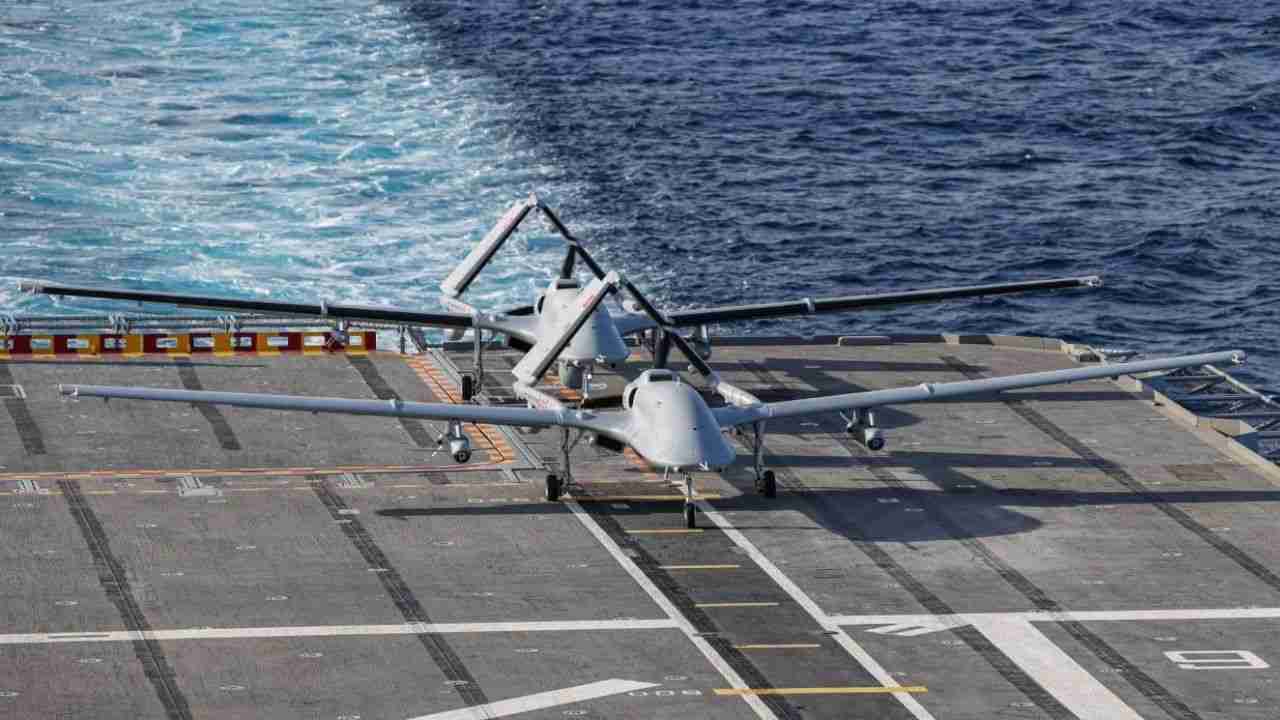
The Turkish Navy conducted an unprecedented coordinated attack involving an aerial drone Bayraktar TB3 and the surface drone Albatros-S, both operating from the aircraft carrier TCG Anadolu.
During the test in the Eastern Mediterranean, the TB3 remotely controlled the kamikaze USV, which advanced against a maritime target and successfully neutralized it. The demonstration included observers from Italy, the United Kingdom, Spain, Japan, and Brazil, highlighting growing interest in combined unmanned systems operations.
The operation also included live fire: one of the TB3s launched smart munitions MAM-T and MAM-L against land targets, while another used KEMANKEŞ-1 missiles. The exercise validated the Turkish concept of hybrid operations, showing how integration between drones from different domains can extend reach, reduce risk, and increase tactical flexibility in modern naval scenarios. After the tests, the aircraft completed return maneuvers to TCG Anadolu and the Keşan base.
The exercise reinforces Turkey’s leadership in the drone sector, driven by Baykar, which already exports UAVs to 37 countries and accounts for a significant portion of Turkey’s international defense sales. In addition to demonstrating operational capability, the test points to future naval warfare concepts, such as ASW patrols with sonar-equipped USVs and coordinated attacks between multiple autonomous platforms—a decisive step toward hybrid fleets that several navies plan for the coming decades.
Source: Naval News | Photo: X @Defense_Talks | This content was created with the help of AI and reviewed by the editorial team
🇹🇷 Bayraktar TB3 Controls ALBATROS-S from TCG ANADOLU, Marking a New Era in Unmanned Naval Warfare
Turkey has achieved another milestone in unmanned combat integration. Taking off from the TCG ANADOLU, the Bayraktar TB3 UCAV successfully provided long-range command and control… pic.twitter.com/qkVgs07NYs
— Global Defense Insight (@Defense_Talks) December 5, 2025
